
Geothermal Heating for Commercial Buildings: A Complete Guide
Why Commercial Buildings Are Ideal Candidates for Geothermal
Did you know that commercial buildings make up almost 18% of total U.S. energy use? And when you look at it closely, heating, ventilation, and air conditioning (HVAC) can take up about 40–60% of a typical commercial building's energy consumption. For facility managers, building owners, and developers who want to cut down on operating costs and achieve sustainability goals, geothermal heating and cooling systems are a fantastic option that often outshines traditional HVAC systems in nearly every long-term aspect.
Unlike residential setups, commercial geothermal systems really take advantage of economies of scale. With larger bore fields, centralized distribution systems, and the ability to use simultaneous heating and cooling zones, commercial geothermal is especially efficient. A well-designed commercial ground source heat pump (GSHP) system can reach Coefficients of Performance (COP) of 4.0–6.0. That means it can provide 4–6 units of heating or cooling energy for every single unit of electrical energy it uses.
This guide is packed with everything facility managers and building owners need to know about geothermal heating for commercial buildings in 2026: from system sizing and ROI analysis to real-world case studies, bore field design, and tips on finding qualified commercial geothermal contractors.
Check out our commercial geothermal heating and cooling services or take a look at leading geothermal manufacturers to discover the commercial systems available to you.
How Commercial Geothermal Systems Work
Commercial ground source heat pump systems work on the same basic idea as residential ones: they exchange heat with the earth using a buried loop field, and then a heat pump boosts that energy for heating or cooling the building. But commercial systems are quite different when it comes to scale, complexity, and design.
Key Components of a Commercial GSHP System
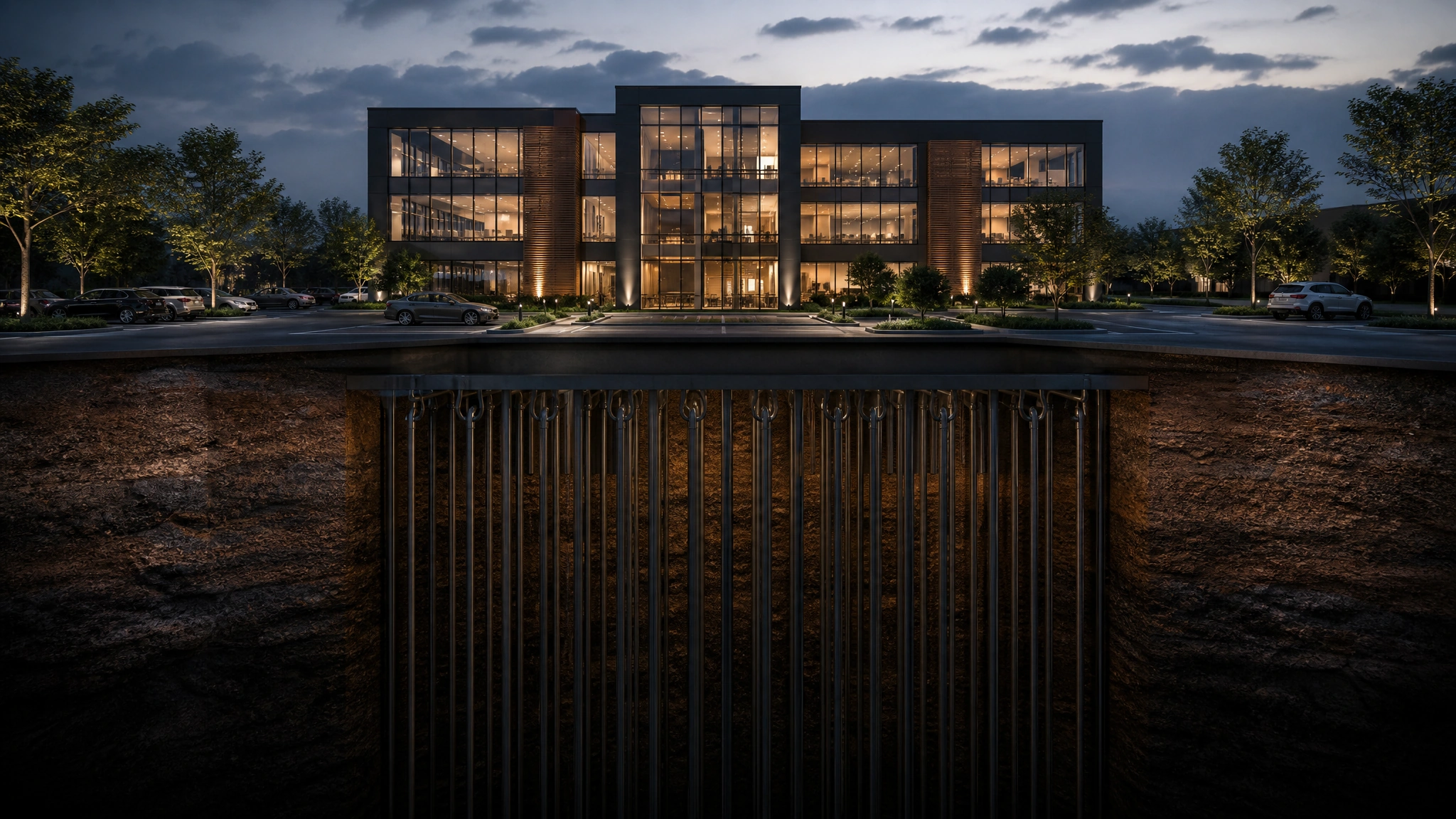
- Ground Loop (Bore Field): This is a network of vertical boreholes (usually 150–500 feet deep) or horizontal trenches that contain high-density polyethylene (HDPE) pipes filled with a heat transfer fluid. In commercial setups, you might find dozens to even hundreds of individual boreholes.
- Heat Pump Units: These are commercial water-to-water or water-to-air heat pumps that either extract or reject heat from the loop fluid. Larger commercial installations often use several modular units for redundancy and to match the load.
- Distribution System: This includes hydronic piping, fan coil units, or variable air volume (VAV) systems that spread conditioned air or water all around the building.
- Controls and Building Management System (BMS): These advanced controls help optimize system performance, manage multiple zones, and integrate with building automation systems.
- Supplemental Equipment: In large commercial systems, you might find cooling towers, fluid coolers, or supplemental boilers to handle peak loads or ground thermal imbalances.
Simultaneous Heating and Cooling: The Commercial Advantage
One of the best perks of commercial geothermal systems is their ability to heat and cool different areas at the same time. For instance, in a typical office building, server rooms and south-facing offices might need cooling, while north-facing offices and lobbies could still require heating—even during winter. A commercial GSHP system can move heat from the cooler areas to those that need warmth, getting close to zero net energy use for these simultaneous demands. This "heat recovery" feature can lower annual energy consumption by 20–40% compared to using separate heating and cooling systems.
System Sizing for Commercial Buildings
Getting the right system size is really important for commercial geothermal installations. If a system’s too small, it won’t handle peak loads, and if it’s too big, you’ll waste money and might even create thermal imbalances in the ground over time. Sizing commercial geothermal systems involves a few essential steps:
Step 1: Building Load Analysis
First off, you’ll want to run a detailed energy model using software like EnergyPlus, eQUEST, or Trane TRACE. This helps you figure out the building's peak heating and cooling loads, annual energy use, and hourly load profiles. This analysis takes into account the building envelope, how people use the space, internal heat gains, and local climate conditions.
Step 2: Ground Thermal Analysis
Next, a Thermal Response Test (TRT) is done to measure the thermal conductivity and borehole thermal resistance of the site’s geology. This information is then plugged into bore field design software, like Earth Energy Designer or GLHEPro, to help optimize borehole depth, spacing, and layout based on the building's specific load profile.
Step 3: Bore Field Design
It's really important to size the bore field to keep loop temperatures in check throughout the system's 25–50 year life span. For buildings that have a good balance of heating and cooling, a standard bore field design usually does the trick. However, if you're dealing with buildings that have mainly cooling loads—like data centers or hospitals—you might need to add some fluid coolers to avoid raising the ground temperature over time.
Typical Commercial System Sizes
| Building Type | Typical Size (Tons) | Boreholes Required | Approx. System Cost |
|---|---|---|---|
| Small Office (5,000 sq ft) | 10–20 tons | 10–20 boreholes | $150,000–$300,000 |
| Medium Office (25,000 sq ft) | 50–100 tons | 50–100 boreholes | $600,000–$1,200,000 |
| K-12 School (80,000 sq ft) | 150–250 tons | 150–250 boreholes | $1,500,000–$3,000,000 |
| Hospital (200,000 sq ft) | 400–800 tons | 400–800 boreholes | $4,000,000–$10,000,000 |
| University Campus | 1,000–5,000+ tons | 1,000–5,000+ boreholes | $10,000,000–$50,000,000+ |
Commercial Geothermal ROI and Payback Analysis
When it comes to commercial geothermal, the financial benefits are pretty convincing, especially for buildings that are going to be around for a while. Sure, the initial costs can be higher than traditional HVAC systems, but when you factor in energy savings, available incentives, and lower maintenance costs, it really makes sense over the long haul.
Energy Cost Savings
Commercial geothermal systems usually cut HVAC energy use by 40–70% compared to standard systems. For example, if you have a 50,000 sq ft office building that's spending $80,000 a year on HVAC energy, switching to a geothermal system could bring those costs down to between $25,000 and $45,000 a year—saving you anywhere from $35,000 to $55,000 annually. Over 25 years, especially with a 3% annual rise in energy costs, those savings can really add up, potentially exceeding $1.5 million.
Federal and State Incentives
Commercial geothermal installations can take advantage of the federal Investment Tax Credit (ITC) at 30% of the total installed cost, thanks to the Inflation Reduction Act. So, for a $1,000,000 installation, you’re looking at a $300,000 tax credit. Plus, commercial setups might also be eligible for accelerated depreciation (MACRS) over 5 years, which brings some pretty significant tax benefits. Don’t forget, many states have their own additional incentives for commercial projects, too. If you want a deeper dive, check out our guide on geothermal ROI and payback period analysis.
Typical Commercial Payback Periods
| Building Type | System Cost | Annual Energy Savings | Federal ITC (30%) | Simple Payback |
|---|---|---|---|---|
| Office Building (50,000 sq ft) | $800,000 | $45,000/yr | $240,000 | 12–15 years |
| K-12 School (80,000 sq ft) | $2,000,000 | $120,000/yr | $600,000 | 11–14 years |
| Hospital (150,000 sq ft) | $5,000,000 | $350,000/yr | $1,500,000 | 10–13 years |
| Hotel (100,000 sq ft) | $3,000,000 | $200,000/yr | $900,000 | 10–12 years |
Case Studies: Commercial Geothermal in Action
Case Study 1: K-12 School District, Minnesota
A school district in suburban Minnesota decided to upgrade an aging 120,000 sq ft elementary school by swapping out old boilers and rooftop units for a 200-ton geothermal system. This system includes 180 vertical boreholes, each going down 300 feet. The project, costing $3.2 million before incentives, qualified for the federal 30% ITC and a state energy efficiency grant, bringing the net cost down to about $1.9 million. With annual energy savings of $165,000, they’re looking at a simple payback period of 11.5 years. Plus, the school got rid of its natural gas connection, cutting carbon emissions by 450 metric tons every year. Both students and teachers have noticed better indoor air quality and more stable temperatures throughout the building.
Case Study 2: Medical Office Complex, Virginia
A 45,000 sq ft medical office complex in Northern Virginia replaced its traditional chiller/boiler system with a 75-ton geothermal setup. The unique heating and cooling needs—like having exam rooms that require cooling while waiting areas need heating—made geothermal's heat recovery feature super helpful. This $1.1 million installation (before incentives) ended up costing $770,000 after factoring in the federal ITC. With annual energy savings of $72,000 and $15,000/year in reduced maintenance costs, the overall payback comes to 8.7 years. Plus, the building earned LEED Gold certification, boosting its market value and making it more attractive to tenants.
Case Study 3: University Residence Hall, Wisconsin
A university residence hall in Wisconsin, with 200 beds, recently set up a 150-ton geothermal system featuring 140 boreholes underneath the nearby parking lot. This $2.4 million project took advantage of the federal ITC and a state Focus on Energy grant. Thanks to it, they're saving around $140,000 a year on energy costs and have eliminated the need for a natural gas boiler, which has really cut down their operating expenses. The university expects to see a full payback in about 12 years, and the system is projected to last over 25 years with very little maintenance. Plus, it’s turned into a great teaching resource for their engineering and environmental science programs.
Case Study 4: Boutique Hotel, Colorado
A charming 60-room boutique hotel in Colorado's Front Range replaced its old rooftop units with a 90-ton geothermal system. Given the hotel’s high demand for domestic hot water—which can really add up in energy costs—they added desuperheaters to capture waste heat from the geothermal system for heating water. The total installation cost $1.6 million, but after incentives, it came down to a net cost of $1.12 million. With annual energy savings of $95,000 (including those hot water savings), they’re looking at a payback period of about 11.8 years. Plus, guests are happier now thanks to quieter operation and more stable room temperatures.
Bore Field Design for Commercial Applications
The bore field’s the core of any commercial geothermal system, and getting its design right can really influence both the initial costs and the long-term performance. When it comes to designing a commercial bore field, there are a few key things to keep in mind:
Borehole Configuration
Boreholes are usually set up in rectangular grids, L-shapes, or U-shapes to keep thermal interference between nearby boreholes at a minimum. The usual spacing is around 15–20 feet, but for larger fields, 20–25 feet is often better. Bore field design software can model heat transfer throughout the system’s lifespan, ensuring that loop temperatures stay within safe limits (generally 25–90°F for the loop fluid).
Thermal Balance
Buildings that have a balanced annual heating and cooling load, like schools and offices, are perfect for geothermal systems since the ground temperature stays stable over time. On the other hand, buildings with heavy cooling needs (like data centers or hospitals with high internal heat gains) might lead to a rise in ground temperature over time, which can hurt system efficiency. To help maintain thermal balance, you can use supplemental fluid coolers or cooling towers to get rid of any excess heat.
Bore Field Under Parking Lots and Plazas
For many commercial projects, it's common to place bore fields underneath parking lots, athletic fields, or plazas. This tactic helps reduce disruption to landscaping and ongoing building activities. Plus, it lets the bore field installation happen alongside building construction, which can speed up project timelines.
Comparing Commercial Geothermal to Conventional HVAC
| Factor | Geothermal GSHP | Gas Boiler + Chiller | Variable Refrigerant Flow (VRF) |
|---|---|---|---|
| Upfront Cost (per ton) | $8,000–$15,000 | $3,000–$6,000 | $4,000–$8,000 |
| Annual Energy Cost (per ton) | $200–$400 | $500–$900 | $350–$600 |
| Maintenance Cost (per ton/yr) | $50–$100 | $150–$300 | $100–$200 |
| System Lifespan | 25–50 years | 15–25 years | 15–20 years |
| Carbon Emissions | Very Low | High | Low–Medium |
| Noise Level | Very Low | Medium | Low |
Financing Options for Commercial Geothermal
If you're looking into commercial geothermal, it's good to know there are a few ways to tackle the higher upfront costs:
- Energy Service Agreements (ESAs): With ESAs, a third-party investor takes charge of the geothermal system, and you, as the building owner, just pay a fixed monthly fee, usually lower than what you’re currently spending on energy. Plus, there’s no need for any upfront cash.
- Power Purchase Agreements (PPAs): Similar to ESAs, PPAs let building owners enjoy the benefits of geothermal without having to invest upfront.
- PACE Financing: Property Assessed Clean Energy (PACE) financing lets commercial property owners fund geothermal installations via a special assessment on their property tax bill, with repayment terms ranging from 10 to 25 years.
- SBA 504 Loans: The Small Business Administration's 504 loan program can help finance energy-efficient upgrades, including geothermal systems, at interest rates that are below market.
- Utility On-Bill Financing: Some utility companies provide on-bill financing programs, letting commercial customers pay for geothermal installation costs through their monthly utility bills.
Finding Qualified Commercial Geothermal Contractors
When it comes to commercial geothermal installations, you need pros who really know their stuff—much more than just residential experience. Here’s what to look for in commercial contractors:
- IGSHPA Accredited Installer certification, along with solid experience in commercial projects
- Proven experience with bore field design software like GLHEPro or Earth Energy Designer
- References from similar commercial projects (think about building type and size)
- In-house drilling capabilities or strong ties with reliable drilling subcontractors
- Familiarity with commercial incentive programs and tax credit paperwork
- Skills in providing detailed energy modeling and financial analysis
Check out our geothermal contractor directory to find certified commercial geothermal installers near you, and don't forget to explore leading geothermal manufacturers for options on commercial systems.
Frequently Asked Questions: Commercial Geothermal
How long does a commercial geothermal installation take?
Installing a commercial geothermal system usually takes about 3 to 12 months, depending on how big and complex the system is. The drilling for the bore field often takes the most time, especially for larger fields, which can need 2 to 4 months of drilling. If you're starting a new construction project, you can plan the geothermal installation alongside the overall construction schedule to keep things running smoothly.
Can geothermal be retrofitted into existing commercial buildings?
Absolutely! Geothermal systems can be retrofitted into most existing commercial buildings. The main challenge is finding room for the bore field and making sure the new system fits with the current distribution setup. Many successful retrofits have been done in buildings that are already occupied, often by phasing the installation so that HVAC service remains uninterrupted.
What is the lifespan of a commercial geothermal system?
The ground loop, or bore field, is built to last over 50 years with almost no maintenance. The heat pump equipment usually lasts around 20 to 25 years. As for the distribution systems—like piping, fan coils, and controls—they have lifespans similar to those of conventional HVAC equipment. This long lifespan is one of the reasons why commercial geothermal systems offer such great lifecycle economics.
Geothermal for Specific Commercial Building Types
Schools and Universities
Schools and universities are some of the best fits for commercial geothermal systems. They usually have predictable schedules, moderate heating and cooling needs, and long-term ownership—which are all great for geothermal’s cost-effectiveness. Many school districts have gone ahead and installed geothermal systems under athletic fields, parking lots, or even open campus spaces, which keeps disruptions to a minimum. The long-term energy savings help free up budget for educational programs, plus these systems can double as live demonstrations for STEM education.
Universities have really embraced geothermal, with many campuses around the country using large-scale district geothermal systems. For example, Ball State University in Indiana boasts one of the largest university geothermal systems in the world, featuring 3,600 boreholes that serve 47 buildings and save about $2 million each year on energy costs.
Healthcare Facilities
Hospitals and medical facilities have some unique HVAC needs: they operate 24/7, require strict control over temperature and humidity, need high ventilation rates, and have a significant demand for hot water. Geothermal systems can meet all these requirements really well. The desuperheater function of geothermal heat pumps can cover a large portion of a hospital's hot water needs, cutting water heating costs by 30–50%. Plus, these systems are reliable and have redundancy (thanks to multiple modular units), which is crucial for healthcare facilities that can’t afford any downtime.
Office Buildings
Modern office buildings often deal with a lot of internal heat from computers, lighting, and people, which can lead to cooling needs even in colder climates. That’s where geothermal comes in handy—it can transfer heat from cooler areas to warmer ones, making it especially useful in office settings. Plus, with variable occupancy, zoned systems featuring individual water-to-air heat pumps in each space can help maintain precise temperature control and improve energy efficiency.
Hotels and Hospitality
Hotels really benefit from geothermal's ability to provide heating, cooling, and hot water all at once. Since guest room occupancy can vary so much, geothermal’s modular design means that individual units can operate only when they're needed. This quiet operation is a huge plus in hospitality, where HVAC noise can impact guest comfort. Many luxury hotel brands have started using geothermal as a unique sustainability feature.
Retail and Mixed-Use Developments
Big retail centers and mixed-use developments can take advantage of geothermal's economies of scale. A shared bore field serving multiple tenants helps lower installation costs for each tenant while still giving them independent control over heating and cooling. Ground leases for bore field installation under parking lots or nearby land can be set up to benefit both property owners and tenants.
Environmental and Sustainability Benefits
Aside from the financial advantages, commercial geothermal offers some impressive environmental perks that really align with corporate sustainability goals and regulatory needs:
- Carbon reduction: A typical commercial geothermal system can cut carbon emissions by 40–70% compared to fossil fuel HVAC, making it easier for organizations to hit those science-based emissions targets.
- LEED certification: Geothermal systems play a key role in earning LEED energy credits, helping buildings reach Gold or Platinum certification.
- ENERGY STAR certification: Buildings equipped with geothermal systems often snag ENERGY STAR certification, which is becoming a must-have for institutional tenants and investors.
- ESG reporting: For publicly traded companies and institutional investors, geothermal installations offer measurable and verifiable data for ESG reporting.
- Regulatory compliance: As building energy codes get stricter and carbon pricing expands, geothermal serves as a solid long-term strategy against regulatory risks.
Conclusion: The Commercial Geothermal Opportunity in 2026
When it comes to commercial geothermal heating and cooling, it’s one of the most attractive investments for building owners and facility managers in 2026. With energy savings ranging from 40–70%, payback periods of about 10–15 years, and system lifespans of 25–50 years, plus the federal 30% Investment Tax Credit helping to lower upfront costs, the financial benefits really stack up for almost any commercial building type.
Across the country, schools, hospitals, offices, hotels, and universities are proving that commercial geothermal can really deliver—cutting energy costs, boosting occupant comfort, and achieving sustainability goals all at once. As energy prices keep climbing and carbon reduction mandates get stricter, the edge that geothermal offers will only become more pronounced.
If you’re interested in looking into commercial geothermal for your building, reach out to certified contractors in our geothermal contractor directory, check out our in-depth ROI and payback analysis, and browse commercial system options from top manufacturers.
Looking for a Geothermal Contractor?
Browse our directory of verified geothermal professionals.
Find Contractors