
Geothermal Loop Systems Explained: Open Loop vs. Closed Loop — Complete Guide
The ground loop's probably the most crucial part of any geothermal heating and cooling system. This network of pipes, whether it's underground or underwater, plays a key role in transferring thermal energy between your home and the earth. The type of loop system you pick will really affect your installation costs, how well the system works, and your overall satisfaction in the long run. So, it's important to know the differences between open loop and closed loop systems — plus the various setups within each type — to make a smart choice for your geothermal installation.
In this detailed guide, we’ll break down every type of geothermal loop system, compare their pros and cons, go over what factors will help you decide which system suits your property best, and equip you to have more effective discussions with your geothermal contractor about loop design.
The Two Main Categories: Closed Loop vs. Open Loop
All geothermal loop systems fit into one of two main categories:
Closed Loop Systems circulate a mixture of water and food-grade antifreeze through a sealed loop made of high-density polyethylene (HDPE) pipe. The fluid stays within the pipe — it just absorbs or releases thermal energy as it moves through the ground and returns to the heat pump. This same fluid keeps circulating for the entire lifespan of the system.
Open Loop Systems use groundwater directly for heat exchange. Water gets pumped from a well, goes through the heat pump's heat exchanger, and is then discharged into another well, a pond, or an approved drainage area. The water isn’t recirculated — fresh groundwater flows through the system all the time.
Each method has its own set of advantages and considerations, which we’ll dive into more below.
Closed Loop Systems: The Most Common Choice
Closed loop systems make up about 85-90% of all residential geothermal installations in the U.S. They’re popular because they’re versatile, reliable, and work well in various site conditions. Within the closed loop category, you’ll find three main setups: horizontal, vertical, and pond/lake.
Horizontal Closed Loop Systems
In a horizontal loop installation, pipes are placed in trenches that are usually 4-6 feet deep and can stretch several hundred feet across your yard. This is often the most budget-friendly closed loop option since trenching is much less expensive than drilling.
Configuration Options
You can set up horizontal loops in a few different ways:
- Straight Run: In this setup, pipes are laid out in a single, straight line in the trench. While it takes up the most land, it's the easiest to install. Usually, you'll find two pipes placed at different depths (like 4 feet and 6 feet) in the same trench to help minimize the total trench length needed.
- Slinky Coil: Here, the pipes are coiled in overlapping loops, similar to a compressed Slinky toy, and laid flat in the trench. This approach packs more pipe length into a shorter trench, cutting down the total trench length by 40-60%. Slinky coils are popular for horizontal configurations because they strike a nice balance between cost, performance, and land requirements.
- Spiral/Helix: This one's like the slinky setup but arranged in a vertical spiral. It's less common but can work well in certain soil conditions.
Advantages of Horizontal Loops
- Lowest installation cost: Trenching costs for a typical residential system range from $15,000 to $25,000, which is 20-35% cheaper than vertical installations.
- Simpler installation: You can use standard excavation equipment like backhoes or trenchers, which are easier to find and less specialized than drilling rigs.
- Easy access for repairs: While it’s very rare for issues to arise, if there’s a problem with a loop, horizontal pipes are easier to reach than vertical ones.
- Effective in most soil types: They work well in clay, loam, and other common soil types that have reasonable thermal conductivity.
Disadvantages of Horizontal Loops
- Requires significant land area: A typical 3-ton system needs about 1,500-2,000 square feet of yard space for trenching, which can be impractical for smaller lots.
- More susceptible to surface temperature variations: At depths of 4-6 feet, horizontal loops can experience slightly more temperature fluctuations due to surface weather compared to deeper vertical loops.
- Landscape disruption: Trenching will temporarily disturb your yard, but it usually gets restored within one growing season.
- Not suitable for rocky terrain: If you're in an area with shallow bedrock or a lot of rock, trenching can be tough or even impossible.
Vertical Closed Loop Systems
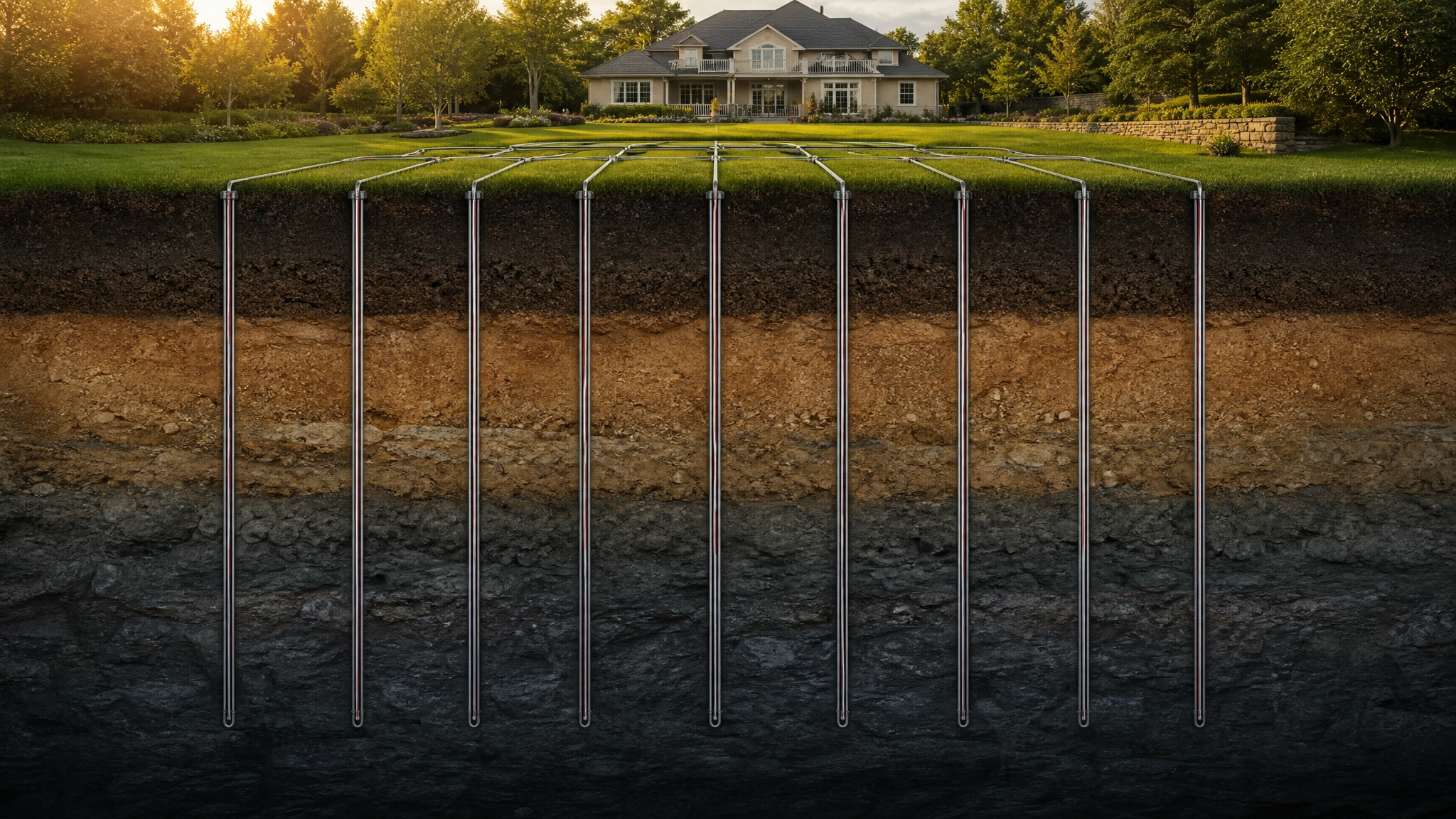
Vertical loop systems involve drilling boreholes 150-400 feet deep, then inserting U-shaped pipe assemblies and backfilling with thermally enhanced grout. Usually, multiple boreholes are drilled, either connected in series or parallel, and they’re spaced about 15-20 feet apart.
Advantages of Vertical Loops
- Minimal surface footprint: The drilling area for a typical residential system can be as small as a standard parking space, which makes vertical loops great for suburban and urban properties where yard space is limited.
- More consistent temperatures: At depths of 150-400 feet, ground temperatures remain really stable and aren’t affected by surface weather, delivering consistent performance throughout the year.
- Works in any soil/rock type: Drilling can go through nearly any geological formation, even solid rock.
- Higher efficiency in many cases: The more stable deep-ground temperatures often lead to slightly better system efficiency compared to shallow horizontal loops.
Disadvantages of Vertical Loops
- Higher installation cost: Drilling boreholes generally costs between $20,000 and $38,000 for a residential system, which is about 25-50% more than horizontal installations.
- Requires specialized equipment: Drilling rigs are large and costly, and they’re not available everywhere. Access to the drilling site can be tricky on some properties.
- Potential environmental concerns: If boreholes aren't sealed properly, they can allow surface contaminants to reach groundwater. So, ensuring proper grouting is crucial and should definitely be checked by your contractor.
- Permit complexity: In some areas, there are specific requirements for vertical boring that can add time and costs to the permitting process.
Pond/Lake Closed Loop Systems
If your property has access to a water body that meets certain criteria, using a pond or lake loop can be a smart and budget-friendly choice. You'd place coils of HDPE pipe at the bottom of the water body, at least 8 feet deep, where the temperatures stay pretty consistent.
Requirements for Pond/Lake Loops
- The water body needs to be at least 8 feet deep at its shallowest usable point.
- It should have a minimum surface area of about half an acre per ton of heating or cooling capacity.
- It must keep enough depth throughout the year (not exposed to extreme seasonal drawdown).
- You must have legal access as the property owner to put equipment in the water body.
Advantages of Pond/Lake Loops
- Lowest installation cost: There’s no need for trenching or drilling — the pipes are just submerged in the water. Costs usually fall between $12,000 and $20,000.
- Excellent thermal contact: Water conducts heat better than soil, which can boost your system’s efficiency.
- No landscape disruption: Since the loop goes into an existing water body, your yard stays intact.
Disadvantages of Pond/Lake Loops
- Requires suitable water body: Not all properties have a pond or lake that meets the necessary size and depth.
- Potential for ice formation: In very cold areas, the spot around the loops might freeze, which can lower efficiency and lead to issues.
- Regulatory requirements: Some states and municipalities have specific rules about placing equipment in natural water bodies.
Open Loop Systems: Maximum Efficiency, Specific Requirements
Open loop geothermal systems utilize groundwater directly as the heat exchange medium. Water's pumped from a supply well, flows through the heat pump to transfer thermal energy, and then gets discharged into a return well, surface water body, or an approved drainage system.
How Open Loop Systems Work
In a typical open loop setup, a submersible pump pulls water from a supply well at about 1.5-3 gallons per minute for each ton of heating or cooling capacity. So, for a 4-ton system, you’d be looking at a requirement of 6-12 gallons per minute. The water flows into the heat pump at a stable ground temperature (usually around 50-60°F), exchanges heat through the heat pump's heat exchanger, and then exits just a few degrees warmer (when heating) or cooler (when cooling). From there, the discharge water is directed to wherever it needs to go.
Advantages of Open Loop Systems
- Highest efficiency: Groundwater is the most effective medium for heat exchange because it keeps a consistent temperature and has great thermal properties. Open loop systems can often hit COP ratings of 5.0 or even higher — that’s the best among all geothermal setups.
- Lower installation cost than vertical closed loop: Since you only need supply and return wells (no extensive loop field), installation costs can be similar to or even lower than closed loop systems in areas where groundwater is easily accessible.
- Excellent for large systems: Open loops are great for scaling up, making them ideal for bigger commercial or residential setups.
Disadvantages of Open Loop Systems
- Requires adequate water supply: You’ll need a well that can reliably produce the necessary flow rate. Not every property has enough groundwater available.
- Water quality concerns: Things like minerals, sediment, or other impurities in the groundwater can lead to scaling, corrosion, or clogging in the heat exchanger over time. It’s crucial to test the water quality before installation.
- Regulatory compliance: Many states and local areas have rules about groundwater withdrawal and discharge. You might need permits, and in some places, open loop systems are completely banned.
- Higher operating costs: The energy needed to keep moving groundwater can add up compared to the small circulating pump used in a closed loop system.
- Environmental considerations: It’s important to address concerns about aquifer depletion, thermal pollution, and groundwater contamination during the design and permitting stages.
Factors That Determine the Best Loop Type for Your Property
Choosing the right loop type really comes down to a few key factors specific to your property:
Available Land Area
This is usually the biggest factor to consider. If you’ve got a good amount of yard space (think at least 1,500-2,000 square feet for trenching), you can go for cost-effective horizontal loops. If your lot's smaller, you’ll likely need to look at vertical installations. And if you have a nearby pond or lake, that’s another option!
Soil and Geology
The way your soil conducts heat plays a big role in how well the loop performs and how long it needs to be. Dense, moist soils like clay or saturated sand do a great job at conducting heat, which means you can use shorter loops. On the flip side, dry, sandy soils don’t conduct heat as well, so they need longer loops. If you’re on rocky terrain, you might not be able to install horizontally, but vertical drilling could work well.
Groundwater Conditions
Having a high water table can really boost the thermal performance of both horizontal and vertical closed loops, thanks to the excellent thermal conductivity of saturated soil. For open loop systems, you’ll want to take a close look at the depth of the aquifer, its yield, and the quality of the water.
Climate Zone
If you live in a colder climate with high heating demands, deep vertical loops might give you some real efficiency advantages compared to shallower horizontal setups. But in moderate climates, those differences aren’t as pronounced.
Budget
The costs for installation can vary quite a bit between different loop types. Generally, horizontal loops are the least expensive for closed loop systems, followed by pond/lake loops, and then vertical loops. For open loops, costs can change a lot based on well conditions and the water treatment you may need.
Local Regulations
Building codes, regulations for well drilling, permits for groundwater use, and environmental protections can all differ depending on where you are, which might limit the types of loops you can choose from. Your geothermal contractor should know the local requirements and take them into account when making their recommendations.
Loop Sizing: Getting It Right
No matter what type of loop you pick, getting the sizing just right is super important. If the loop's too small, it won't transfer enough thermal energy, which means your system has to work harder, uses more electricity, and might even break down during those really hot or cold spells. On the flip side, if it’s too big, you’ll end up spending extra money on unnecessary piping and installation costs.
When it comes to professional loop sizing, here’s what’s taken into account:
- Your home's heating and cooling requirements (calculated using Manual J)
- Local soil thermal conductivity (either measured or estimated based on geological info)
- Loop layout and pipe size
- Annual balance between heating and cooling needs
- Local undisturbed ground temperature
Many geothermal contractors rely on specialized design software like LoopLink or GLD (Ground Loop Design) to determine the best loop field dimensions tailored to your property and system.
Loop Materials and Construction Quality
The materials and construction methods you choose for your ground loop installation really affect how long it lasts and how well it performs:
Pipe Material
For closed loop systems, high-density polyethylene (HDPE) is the go-to choice. Make sure the pipe meets the IGSHPA specification, which outlines the necessary material properties, wall thickness, and pressure ratings. Ideally, the pipe should come with at least a 50-year warranty and be rated for the pressures and temperatures you’ll encounter in geothermal setups.
Pipe Connections
All connections within the ground loop should use thermal fusion. This method melts the ends of the pipes together, creating a joint that’s as strong, if not stronger, than the pipe itself. Avoid using mechanical fittings like clamps or compression fittings underground, since they can develop leaks over time. When done right, thermal fusion joints are leak-proof for the entire lifespan of the system.
Grout Quality (Vertical Loops)
The grout that fills vertical boreholes has two key roles: it helps transfer heat between the pipe and the surrounding earth, and it seals the borehole to stop groundwater contamination. Always use thermally enhanced grout with high thermal conductivity; standard bentonite grout has lower thermal conductivity and could reduce system performance by 10-20%.
Long-Term Performance and Maintenance
One of the best things about ground loops is their incredible longevity and low maintenance needs. When you’ve got a properly installed closed loop system, you can expect virtually no maintenance during its impressive 50+ year lifespan. The HDPE pipe is tough—it won't corrode, degrade, or lose performance over time. You might need to test and possibly top off the antifreeze solution every 5-10 years, but that’s a pretty minor task.
Open loop systems do need a bit more care—like regular water quality testing, pump upkeep, and checking discharge conditions. But with the right system design and water treatment (if necessary), open loop systems can also deliver reliable service for many years.
Conclusion: Trust Your Contractor's Expertise
Getting to know the different loop types helps you engage in the design process, but the best recommendation for the right loop type should really come from a skilled geothermal contractor who's looked at your specific property. A knowledgeable contractor will take into account your soil conditions, available space, groundwater potential, local regulations, and budget to suggest the best loop setup for you.
The great news is that all loop types, when designed and installed correctly, provide the amazing efficiency and comfort that make geothermal the top choice for heating and cooling. Check out our directory to find a qualified geothermal contractor who can give you a professional assessment of your property's loop options.
Looking for a Geothermal Contractor?
Browse our directory of verified geothermal professionals.
Find Contractors