
How Geothermal Heating and Cooling Systems Work: A Complete Technical Guide
You might not realize it, but geothermal heating and cooling technology has been quietly changing how we experience comfort at home for quite some time. Unlike traditional HVAC systems that burn fuel or depend only on outside air temperatures, geothermal systems harness the stable thermal energy stored beneath the earth's surface to deliver incredibly efficient heating, cooling, and even hot water for your home. So, how does this technology really work? And what makes it so much more efficient than the usual options?
In this detailed guide, we’ll walk you through every part and process that makes up a geothermal heating and cooling system — from the science behind underground heat exchange to how the heat pump operates. Whether you’re a homeowner thinking about getting one installed or just curious about what this tech is all about, this guide will help you understand how geothermal energy is powering modern homes.
The Fundamental Principle: Earth as a Thermal Battery
To get a grasp on geothermal HVAC, you need to know one important fact: the temperature just below the earth's surface stays surprisingly stable all year long. While temperatures above ground can vary from well below freezing in winter to over 100°F in summer, the ground temperature just 6–10 feet down typically ranges between 45°F and 75°F, depending on where you are. In most of the continental U.S., that underground temperature is usually around 50–60°F throughout the year.
This consistent underground temperature happens because the earth absorbs about 47% of the sun's energy that hits our planet. This huge amount of thermal energy gets stored in the ground, forming what engineers refer to as a "thermal reservoir" or, more poetically, a natural thermal battery. Geothermal systems simply tap into this reservoir, moving heat from where it is to where it's needed.
The idea is beautifully straightforward: in winter, the ground's warmer than the outside air, so the system pulls heat from the earth and brings it into your home. In summer, the ground's cooler than the outside air, so the system takes heat from your home and sends it back into the earth. The ground serves as both a heat source and a heat sink, depending on the season.
The Three Core Components of a Geothermal System
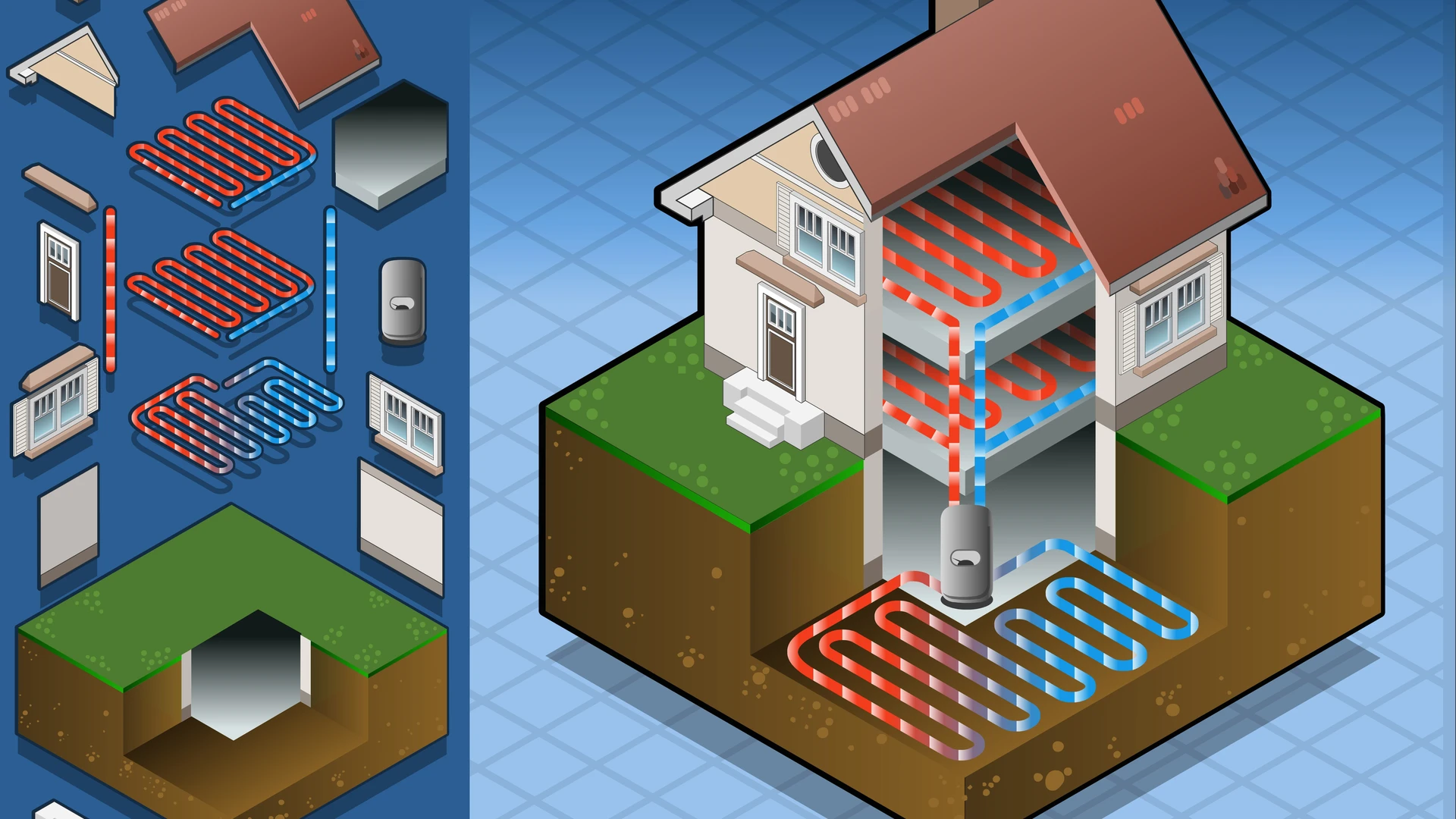
Every geothermal heating and cooling system has three connected components that work together to move thermal energy around. Knowing about each part is key to understanding how the entire system operates.
1. The Ground Loop (Earth Connection)
The ground loop is the outdoor part of a geothermal system — it’s a network of pipes buried underground or placed in a body of water. These pipes, usually made of high-density polyethylene (HDPE), are built to last over 50 years and carry a heat-transfer fluid (typically a water-antifreeze mix) that either absorbs or releases thermal energy as it moves through the earth.
There are four main ground loop configurations, each designed for different properties and site conditions:
Horizontal Closed Loop
In this setup, pipes are placed in trenches that are 4–6 feet deep and can stretch several hundred feet across your property. The trenches are usually 6 feet wide, and the pipes are arranged in a slinky coil or straight-run pattern. Horizontal loops are the most cost-effective option when you have enough land, since trenching costs less than drilling. A typical residential system needs about 1,500–2,000 feet of pipe for a 3-ton system. The pipes are installed below the frost line to keep ground temperatures stable all year round.
Vertical Closed Loop
When space is tight, especially in suburban areas, vertical loops are often the way to go. Boreholes are drilled anywhere from 150 to 400 feet deep, usually about 15 to 20 feet apart, and U-shaped pipe assemblies are placed into each hole. After that, the holes are backfilled with a thermally enhanced grout, which helps with efficient heat transfer between the pipes and the surrounding earth. While vertical installations need specialized drilling equipment and can be pricier, they have the smallest surface footprint of any loop configuration.
Pond/Lake Loop
If you've got access to a body of water that's at least 8 feet deep and has enough volume, a pond or lake loop can be a fantastic choice. Coils of pipe are set at the bottom of the water, where the temperatures stay pretty stable. This approach completely removes the need for trenching or drilling, which can really help cut down on installation costs. Just make sure that the water body has enough depth all year round to avoid freezing around the loops.
Open Loop System
Open loop systems tap into groundwater directly as the heat exchange medium. Water is pumped from a well, goes through the heat pump to either extract or deposit thermal energy, and then gets discharged to a second well (the return well), a pond, or an approved drainage system. Open loops can be highly efficient since groundwater has great thermal properties and keeps temperatures quite consistent. However, they do need a reliable and clean water supply, proper permits, and compliance with local groundwater regulations.
2. The Heat Pump Unit (Indoor Equipment)
The geothermal heat pump is really the core of the system — it’s the device that moves thermal energy between the ground loop and your home’s air distribution system. You’ll typically find it indoors, like in a basement, utility closet, or mechanical room. It’s about the same size as a standard furnace and works on the same refrigeration cycle principles as your kitchen refrigerator, just on a larger scale.
Inside the heat pump, you’ll find a few key components:
- Compressor: This is the workhorse of the system, pressurizing refrigerant gas to raise its temperature. Modern geothermal heat pumps often use scroll compressors or variable-speed compressors that adjust their output based on demand, which really boosts efficiency and comfort.
- Expansion Valve: This device quickly reduces the pressure of the liquid refrigerant, causing it to cool significantly as it expands. The expansion valve manages the flow of refrigerant through the system and plays a crucial role in the heat exchange process.
- Heat Exchangers: There are two heat exchangers that make the actual transfer of thermal energy happen. One exchanges heat between the ground loop fluid and the refrigerant, while the other does so between the refrigerant and the air circulating through your home’s ductwork.
- Refrigerant: This special fluid circulates within the heat pump in a closed loop, absorbing and releasing heat as it transitions between liquid and gas states. Today’s systems often use eco-friendly refrigerants like R-410A or R-454B.
- Desuperheater (optional): Many geothermal heat pumps come with a desuperheater— a small auxiliary heat exchanger that captures extra heat from the compressor to preheat domestic hot water. This can give you free hot water in summer and cheaper hot water in winter.
3. The Distribution System (Home Delivery)
The distribution system is what delivers the conditioned air throughout your home. In most cases, this means a standard ductwork system similar to what you’d see in any conventional HVAC setup. You can usually reuse existing ductwork with a geothermal retrofit, though it might need to be resized or rebalanced for the best performance.
If your home doesn’t have ductwork, geothermal systems can still be a great choice with options like radiant floor heating, hydronic baseboard heaters, or ductless mini-split systems. These alternatives can actually be more efficient than traditional forced-air systems since they cut down on the energy losses that come from ductwork.
The Heating Cycle: How Geothermal Warms Your Home
When it’s heating season, your geothermal system kicks into action with a smart four-step process that brings heat from the ground right into your home:
Step 1: Heat Absorption from the Ground
The fluid in the ground loop soaks up thermal energy from the earth as it moves through the buried pipes. Even when it’s freezing outside, the ground at the loop’s depth stays warm, typically between 45–60°F. The fluid starts off relatively cool (around 30–40°F) and comes back to the heat pump a few degrees warmer, carrying that warmth from the earth.
Step 2: Heat Transfer to Refrigerant
Inside the heat pump, the warmed ground loop fluid goes through the first heat exchanger (known as the evaporator), where it transfers its heat to the refrigerant. Since the refrigerant has a really low boiling point, it absorbs the heat and turns from a cold liquid into a warm gas. The now-cooled ground loop fluid is then pumped back underground to gather more heat, and the process keeps going.
Step 3: Compression and Temperature Boost
Next, the warm refrigerant gas is compressed by the compressor, which significantly raises both its pressure and temperature. This step is crucial for how geothermal (and all heat pump) technology works—by compressing the gas, the system concentrates the thermal energy, boosting the refrigerant temperature to 140–160°F or even higher. That’s more than enough to keep your home cozy, even on the chilliest winter days.
Step 4: Heat Delivery to Your Home
The hot, high-pressure refrigerant gas moves into the second heat exchanger, known as the condenser. Here, it gives off its concentrated heat to the air that's being circulated through your home's ductwork. A blower fan helps push this warm air through the ducts and into your rooms. As the refrigerant releases its heat, it turns back into a liquid, then goes through the expansion valve to cool down, and the cycle starts all over again.
The Cooling Cycle: How Geothermal Cools Your Home
When the geothermal system is in cooling mode, it basically flips the heating process on its head. Thanks to a reversing valve inside the heat pump, the refrigerant flow gets redirected, turning the system from a heater into an air conditioner:
Step 1: Warm air from your home gets blown across the indoor heat exchanger, where the cold refrigerant soaks up the heat, cooling the air that gets sent back into your rooms.
Step 2: The refrigerant, now carrying heat from your home, gets compressed and pumped to the ground loop heat exchanger.
Step 3: The hot refrigerant transfers its heat to the ground loop fluid, which then carries it underground and releases it into the cooler earth.
Step 4: The cooled refrigerant makes its way back to the indoor unit to absorb more heat from your home, and then the whole cycle starts over again.
This process is super efficient because the ground temperature (around 50–60°F) is way cooler than the summer air temperature. A typical air conditioner has to release heat into outdoor air that’s over 95°F, which takes a lot more energy. The geothermal system can dump heat into 55°F ground, making it 30–50% more efficient for cooling than even the top conventional air conditioners.
Understanding Geothermal Efficiency: COP and EER
When it comes to geothermal system efficiency, we look at two main metrics:
Coefficient of Performance (COP)
COP tells us about heating efficiency — it’s the ratio of heating energy output to the electrical energy input. A geothermal system with a COP of 4.0 produces 4 units of heating energy for every 1 unit of electrical energy it uses. In simpler terms, this means the system is 400% efficient, giving you four times more energy than it consumes. In comparison, a high-efficiency gas furnace operates at 96% efficiency, and an air-source heat pump typically has a COP of 2.0–3.0.
Energy Efficiency Ratio (EER)
EER focuses on cooling efficiency — it’s the ratio of cooling output (measured in BTUs) to electrical input (in watts). The best geothermal systems can achieve EER ratings of 25–30 or higher, while the top conventional central air conditioners usually range from 13–20. A higher EER means lower electricity bills and a smaller environmental footprint.
These impressive efficiency figures are possible because geothermal systems don’t actually generate heat; they just move existing thermal energy from one spot to another. Moving heat takes a lot less energy than creating it, which is why a geothermal system can provide 3–5 times more thermal energy than the electrical energy it uses.
Water-to-Water vs. Water-to-Air Systems
Geothermal heat pumps generally come in two main types, and they differ in how they deliver conditioned energy to your home:
Water-to-Air Systems
Water-to-air systems are the most common choice for residential use. They heat or cool air directly using a forced-air blower and ductwork. If your home already has ductwork, these systems are a great fit since they provide both heating and cooling from a single unit. Plus, they offer rapid temperature response and easily integrate with your existing HVAC setup.
Water-to-Water Systems
On the other hand, water-to-water systems heat or cool water instead of air, making them ideal for things like radiant floor heating, hydronic baseboard systems, or even snow-melt applications. These systems deliver extremely even, comfortable heating and can be paired with a fan coil unit for forced-air cooling if you need it. They're especially popular in high-performance homes and buildings where radiant heating is a must.
The Role of the Thermostat and Controls
Today’s geothermal systems are controlled by advanced digital thermostats and control systems that really enhance performance. Smart thermostats can get to know your routine, adjust temperatures based on who’s home, and even keep an eye on how the system’s working in real-time. A lot of manufacturers provide Wi-Fi-enabled controls that let you check and adjust your system right from your smartphone, track energy use, and get maintenance reminders.
Plus, these advanced control systems can handle multi-zone setups, meaning different parts of your home can be heated or cooled to different temperatures with their own thermostats. This zoning feature boosts both comfort and efficiency by making sure you're not heating or cooling rooms that aren’t being used.
Geothermal System Lifespan and Reliability
One of the biggest advantages of geothermal technology is how long it lasts. The indoor heat pump unit usually sticks around for about 20–25 years — which is on par with a good furnace, but it definitely outlasts a standard air conditioner, which typically only lasts around 12–15 years. As for the ground loop, since it doesn’t have any moving parts and isn’t exposed to the elements, it can last 50 years or more. In fact, many ground loops from the 1970s and 1980s are still going strong today.
Geothermal systems also come with fewer mechanical components compared to traditional HVAC systems — there’s no outdoor condensing unit that has to brave the weather, no gas burner, no flue, and no combustion-related parts. This simplicity means lower maintenance costs and fewer breakdowns throughout the system’s life.
Common Misconceptions About How Geothermal Works
There are quite a few myths about geothermal technology that we should clear up:
- "Geothermal only works in warm climates": That’s not true! Ground temperatures stay pretty stable no matter what’s happening above ground, so geothermal systems can work really well even in the coldest states. In fact, people often see the biggest savings on heating costs in those chilly areas.
- "Geothermal systems use volcanic heat": Nope, that’s not the case for residential systems. While larger geothermal power plants do harness deep volcanic heat, residential geothermal HVAC systems rely on the shallow ground temperatures that come from solar energy soaking into the earth’s surface.
- "The system depletes the earth's energy": This is also false. Geothermal systems draw on thermal energy that’s constantly replenished by solar radiation. When designed properly, these systems can maintain a thermal balance with the surrounding earth for as long as they’re in use.
- "You need a huge property": Not at all! Vertical loop systems can fit into pretty small lots—even in busy urban areas. For an average home, you might only need a space as small as a standard parking spot.
Conclusion: Proven Technology for the Future
Geothermal heating and cooling isn’t just a concept — it’s a proven, reliable, and incredibly efficient method for keeping your home comfortable. By tapping into the steady thermal energy stored underground, geothermal systems provide exceptional comfort while using far less energy than traditional HVAC systems. This technology has been fine-tuned over the years and keeps getting better with improvements in compressor design, control systems, and loop technology.
If you’re building a new home or updating an existing one, getting a grasp on how geothermal works is the first step to making a smart choice. When you’re ready to move forward, check out our directory of certified geothermal contractors to find a qualified installer nearby who can evaluate your property and create a system that fits your unique needs.
Looking for a Geothermal Contractor?
Browse our directory of verified geothermal professionals.
Find Contractors