
Vertical vs Horizontal Ground Loops: Which Is Right for You?
Understanding Ground Loop Systems: The Foundation of Geothermal
The ground loop is really the heart of any geothermal heating and cooling system. Buried underground, it circulates a heat transfer fluid that swaps thermal energy with the stable temperature of the earth—pulling heat out in winter and releasing it in summer. The type and design of the ground loop you pick will significantly affect installation costs, land needs, long-term performance, and overall system efficiency.
The two most common ground loop setups are vertical loops and horizontal loops. Each comes with its own set of benefits and drawbacks, so the best choice depends on your property's geology, how much land you've got, your budget, and the skills of local contractors. This guide offers a thorough comparison to help you make the best decision.
If you want to understand how geothermal systems work as a whole, check out our guide on how geothermal heating and cooling systems work. For a broader look at different loop types, including open-loop and pond/lake systems, take a look at our article on geothermal loop systems: open vs. closed loop.
How Vertical Ground Loops Work
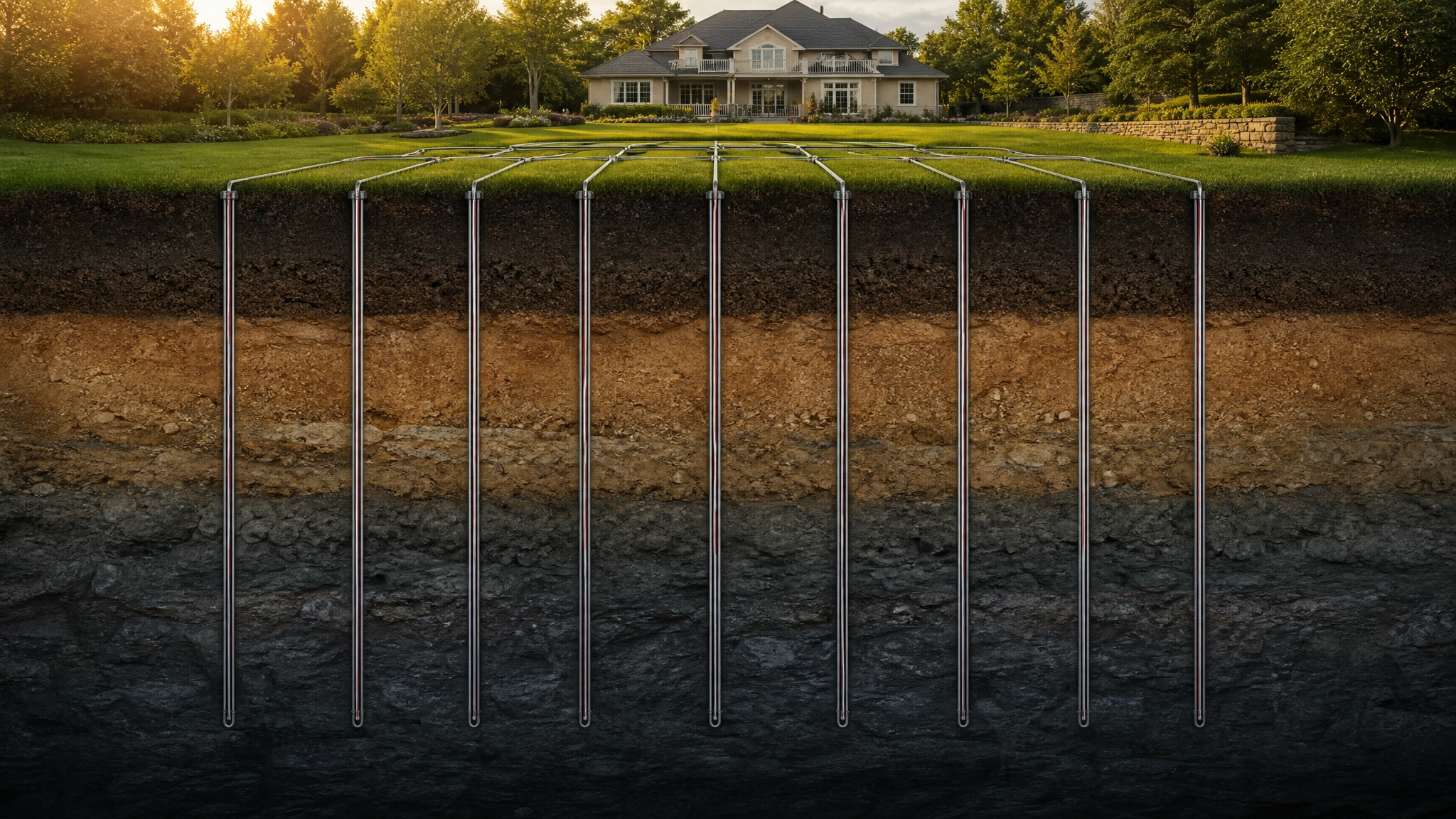
Vertical ground loops are set up by drilling one or more boreholes straight down into the ground, usually reaching depths of 150 to 500 feet per borehole. A U-shaped loop made of high-density polyethylene (HDPE) pipe gets inserted into each borehole, and then the hole is grouted (filled with a thermally conductive material) to ensure it has good contact with the surrounding rock or soil and to avoid any groundwater contamination.
The individual borehole loops connect at the surface via a header manifold, which links up to the heat pump inside the building. The heat transfer fluid, typically water mixed with a little propylene glycol antifreeze, circulates through the loop, soaking up heat from the earth during winter and releasing heat back to the earth in summer.
Key Characteristics of Vertical Loops
- Depth: 150–500 feet per borehole (most residential systems usually go for 200–350 feet)
- Number of boreholes: Generally 1–6 for residential systems (1–2 boreholes for each ton of capacity)
- Borehole diameter: 4–6 inches
- Borehole spacing: At least 15–20 feet apart to avoid thermal interference
- Grouting: Thermally enhanced grout fills the borehole around the pipe
- Ground temperature: Reaches deeper, more stable ground temperatures (50–60°F in most parts of the US)
How Horizontal Ground Loops Work
Horizontal ground loops are set up by digging trenches about 4 to 8 feet deep. In those trenches, HDPE pipe is arranged in different ways—like single pipes, double pipes, or slinky coils—and then the trenches are filled back in. The pipe connects to a header manifold that leads to the heat pump inside the building.
Horizontal loops are placed at shallower depths compared to vertical loops, where ground temperatures are more affected by seasonal changes. But at 4 to 8 feet deep, the ground temperatures stay pretty consistent (usually between 45 and 65°F depending on the climate and the season), which makes for effective heat exchange all year round.
Key Characteristics of Horizontal Loops
- Depth: 4–8 feet below surface
- Trench length: 400–600 feet per ton of capacity (standard single-pipe layout)
- Slinky coil layout: Cuts trench length by 30–50% by coiling the pipe
- Land area required: 1,500–3,000 sq ft per ton of capacity (standard layout)
- Pipe configurations: Single pipe, double pipe, slinky coil, or multiple parallel circuits
- Ground temperature: More seasonal variation than vertical loops, but still effective
Installation Cost Comparison
When it comes to choosing between vertical and horizontal loops, cost is usually the main concern. Let’s break it down:
Vertical Loop Costs
The biggest expense for vertical loop installation comes from drilling, and this can really vary depending on the geology:
- Drilling cost: $15–$30 per foot for soft soil/sediment, and $25–$50 per foot for hard rock.
- Typical residential borehole: 300 feet × $20/foot = $6,000 per borehole.
- 3-ton system (3 boreholes): Expect to pay $18,000–$45,000 just for drilling.
- Total vertical loop system cost: Generally, it’ll run you between $20,000 and $35,000 for a standard 3-ton residential system.
- High-end (hard rock, deep drilling): Costs can go up to $30,000–$50,000 or more.
Horizontal Loop Costs
Horizontal loop installation relies on excavation equipment like backhoes and trenchers instead of drilling rigs, which usually makes it a more budget-friendly option:
- Excavation cost: $3–$8 per linear foot of trench
- Pipe cost: $0.50–$1.50 per foot of HDPE pipe
- Typical 3-ton system: 1,200–1,800 feet of trench
- Total horizontal loop system cost: $10,000–$20,000 for a typical 3-ton residential system
- Slinky coil layout: Can cut costs by 20–30% by shortening trench length
Cost Comparison Table
| Factor | Vertical Loops | Horizontal Loops |
|---|---|---|
| Installation method | Drilling rig | Backhoe/trencher |
| Typical depth | 150–500 feet | 4–8 feet |
| Cost per ton (loop only) | $5,000–$12,000 | $2,500–$6,000 |
| Total system cost (3-ton) | $20,000–$35,000 | $10,000–$20,000 |
| Land area required | Small (drilling footprint only) | Large (1,500–3,000 sq ft/ton) |
| Disruption to landscaping | Minimal | Significant (temporary) |
| Geology sensitivity | High (hard rock = higher cost) | Low (most soils work) |
| Seasonal temperature variation | Minimal | Moderate |
| Long-term efficiency | Slightly higher | Slightly lower |
Land Requirements: A Critical Decision Factor
The amount of available land is often what tips the balance between choosing vertical or horizontal loops. Here’s what you need to know about each system’s requirements:
Vertical Loop Land Requirements
Vertical loops take up a pretty small surface area—just enough for the drilling rig to do its thing and for the borehole header manifold. For a typical home installation with 3–4 boreholes, you’ll need around 500–1,000 sq ft of accessible space for the drilling rig. The boreholes themselves only take up a few square feet of surface area permanently.
This makes vertical loops a great option for:
- Urban and suburban lots where yard space is tight
- Properties with mature landscaping that owners want to keep
- Lots with buildings, driveways, or other structures covering most of the yard
- Properties where the loop field can be placed under a parking area or driveway
Horizontal Loop Land Requirements
Horizontal loops, on the other hand, need a lot more land. A standard single-pipe layout typically requires around 1,500–2,000 sq ft per ton of system capacity. So for a usual 3-ton residential system, you’re looking at needing about 4,500–6,000 sq ft of open, unobstructed land—roughly the size of a large suburban backyard.
Using slinky coil layouts can cut down land needs by 30–50%, but you’ll still need a decent amount of open space. Plus, the trenching process can temporarily disrupt the entire loop field area, so you’ll need to restore the landscaping afterward.
Horizontal loops work best for:
- Rural properties with plenty of open land
- New builds where the loop field can go in before landscaping
- Properties with soft, easily dug-up soil
- Situations where getting drilling equipment in is tough or costly
Drilling vs. Trenching: The Installation Process
Vertical Loop Drilling
When it comes to vertical loop installation, you’ll need a rotary drilling rig, which is pretty similar to what's used for water well drilling. Here’s how the process goes:
- First, we mobilize the drilling rig to the site (just make sure there’s enough access for a big truck)
- Next, we drill each borehole down to the specified depth
- Then, we insert the U-loop pipe into the borehole
- After that, we grout the borehole from the bottom to the top
- We connect all the individual boreholes to the header manifold
- Finally, we pressure test the completed loop system
Typically, drilling takes about 1–3 days for a residential setup, but that can vary based on how many boreholes you need and the geological conditions. If we hit hard rock formations, it can really slow things down and drive up costs. Plus, the drilling creates drill cuttings (like rock chips and soil) that we'll need to manage on-site.
Horizontal Loop Trenching
For horizontal loop installation, we use a backhoe or chain trencher to dig trenches down to the required depth. Here’s what the process looks like:
- We start by marking and excavating trenches that are 4–8 feet deep
- Next, we lay the pipe in the trenches (either in straight runs or slinky coils)
- Then, we connect the pipe circuits to the header manifold
- We pressure test the loop system
- Finally, we backfill the trenches and restore the surface
Horizontal installation is usually quicker than vertical drilling for smaller systems. However, the extensive trenching and backfilling can take around 2–5 days, and it can leave your yard looking pretty disturbed. Plus, restoring your lawn and landscaping will add some extra time and costs to the project.
Efficiency Comparison: Vertical vs. Horizontal
Both vertical and horizontal loops can provide great performance for geothermal systems, but there are some efficiency differences that it's good to know about:
Ground Temperature Stability
Vertical loops tap into deeper ground temperatures that stay pretty stable throughout the year. At depths of 200–400 feet, ground temperatures usually fluctuate by just 1–2°F with the seasons. This stability means the heat pump can run close to its ideal design conditions all the time.
On the other hand, horizontal loops, which sit at depths of 4–8 feet, deal with more seasonal temperature changes—around 5–15°F between summer and winter in colder areas. Because of this, the heat pump might not work quite as efficiently on the coldest winter days (when the loop temperature drops) and the hottest summer days (when it rises).
Practical Efficiency Difference
In real-world terms, the efficiency gap between well-designed vertical and horizontal loop systems is fairly minor—generally around 5–15% in annual energy use. Both systems can reach COP values of 3.5–5.0 under normal operating conditions. The efficiency edge of vertical loops really shows up in extreme climates, like those with harsh winters or scorching summers.
Pros and Cons Summary
| Factor | Vertical Loops | Horizontal Loops |
|---|---|---|
| Upfront Cost | Higher ($20K–$35K) | Lower ($10K–$20K) |
| Land Required | Minimal | Substantial |
| Landscaping Disruption | Minimal | Significant (temporary) |
| Efficiency | Slightly higher | Slightly lower |
| Geology Sensitivity | High | Low |
| Installation Time | 1–3 days (drilling) | 2–5 days (trenching) |
| Maintenance Access | No access to loop | Shallow, potentially accessible |
| Best For | Small lots, rocky terrain | Large lots, soft soil |
| Lifespan | 50+ years | 50+ years |
Hybrid and Alternative Loop Configurations
Hybrid Vertical-Horizontal Systems
Some setups mix vertical and horizontal loops to get the best balance of cost and performance. For instance, if a property has limited yard space, it might use two vertical boreholes along with a short horizontal loop in a nearby area. Designing hybrid systems takes some care to make sure the flow and thermal performance are well-balanced.
Slinky Coil Horizontal Loops
Slinky coil designs twist the HDPE pipe into overlapping circles within the trench, which lets you fit more pipe into each linear foot of trench. This can cut down the total trench length by 30–50%, making horizontal loops a great option for smaller properties. Just keep in mind that the coiled pipe can cause a bit more thermal interference between sections, which might slightly affect efficiency compared to straight-run layouts.
Pond/Lake Loops
If a property has access to a suitable pond or lake, a pond/lake loop system can be a fantastic choice. This setup submerges coiled HDPE pipe in the water body. Pond loops are usually the least expensive closed-loop option since they don’t require drilling or extensive trenching, and they can be really efficient thanks to water's great heat transfer abilities. However, they do need a sufficiently large and deep water body to work effectively.
Decision Guide: Which Loop Type Is Right for You?
Check out this decision guide to help you figure out the best loop type for your property:
Choose Vertical Loops If:
- Your lot is smaller than 1/4 acre or you’ve got limited open yard space
- You want to keep your mature landscaping intact
- Your property has buildings, driveways, or other structures that take up most of the yard
- You live in an area with extreme weather (like really cold winters or super hot summers) where getting the most efficiency is key
- Your soil is rocky or doesn’t conduct heat well (vertical loops work great in rocky soil)
- You're more focused on minimizing disruption than sticking to a budget
Choose Horizontal Loops If:
- You have at least 1/2 acre of open, unobstructed land
- You’re building a new home and can set up the loop before doing any landscaping
- Your soil is soft and easy to dig up (like clay, loam, or sandy soil)
- Keeping your upfront costs low is a priority
- It’s tough or pricey to get drilling equipment onto your property
- You live in a moderate climate (not too hot or too cold)
The Role of a Geothermal Contractor in Loop Selection
Even though this guide gives you a solid overview of vertical versus horizontal loops, it’s really important to talk with a qualified geothermal contractor before making a final choice. They can help assess your unique site conditions. A thorough site assessment should cover:
- Evaluating soil and geology (through soil borings or checking local geological data)
- Measuring the available land area
- Checking access for drilling equipment
- Getting quotes for local drilling costs
- Calculating the building load to figure out the system capacity you’ll need
- Designing the loop using professional software like GLHEPro or Earth Energy Designer
If you need help finding a qualified contractor, check out our geothermal installation process guide and take a look at our geothermal contractor directory. For more detailed cost info, don’t miss our geothermal cost guide.
Installation Considerations and Site Assessment
Soil and Geological Testing
Before you settle on your loop type, it's really important to do a thorough site assessment. If you're going for vertical loop systems, a Thermal Response Test (TRT) is a great way to measure how well your site's geology conducts heat. This test involves drilling a test borehole, circulating fluid through it, and tracking the temperature response over 48 to 72 hours. The data collected helps engineers fine-tune the borehole depth and spacing, which can save you a lot of money by preventing over-design.
For horizontal loop systems, soil borings or test pits can give you insight into the soil composition, moisture content, and how deep bedrock is. Soils that are moist and rich in clay have excellent thermal conductivity, making them perfect for horizontal loops. In contrast, dry, sandy soils will need longer loop lengths to achieve the same level of heat exchange.
Permitting Requirements
When it comes to installing vertical and horizontal loops, you'll usually need permits, but the specifics can vary quite a bit depending on where you live:
- Vertical drilling permits: In most states, you'll need a well drilling permit for vertical boreholes, even if they aren't for water. Some states require that licensed well drillers handle the work.
- Horizontal excavation permits: For horizontal loop installations, you might need excavation permits, and you'll have to follow utility locating requirements (don’t forget to call 811 before you dig).
- Environmental permits: In certain states, closed-loop systems need environmental permits to make sure that the loop fluid doesn't contaminate groundwater.
- HOA approval: If you're part of a homeowners association, you might need their approval for the installation, especially for horizontal loops that can temporarily disrupt the landscaping.
Your geothermal contractor should take care of all the necessary permits during the installation process. Just make sure to check that this is included in your contract before you sign on the dotted line.
Contractor Equipment and Expertise
The availability of qualified contractors with the right tools can really affect your choice of loop type. Vertical drilling needs special rotary drilling rigs that not every geothermal contractor has or can access. In some rural areas, they might even have to bring in drilling contractors from far away, which can drive up costs. On the other hand, horizontal loop installation uses more common excavation equipment, like backhoes and trenchers, that’s pretty widely available.
When you're looking at contractors, it’s a good idea to ask about their experience with your preferred loop type and to ask for references from similar projects. If a contractor mainly installs horizontal loops, they might not be the best fit for a vertical system, and the same goes the other way.
Seasonal Installation Timing
You can generally install both vertical and horizontal loops year-round in most climates, but there are some ideal timing tips to keep in mind:
- Horizontal loops: Spring and fall are the best times— the soil is workable but not frozen, and you’ll have time for landscaping restoration before summer or winter sets in. It’s best to avoid installing during droughts when the soil is super dry and hard.
- Vertical loops: You can install these year-round in most climates. Winter installations are possible, but they might cost more because of the frozen ground at the surface.
- New construction: If you’re building a new home, it’s smart to install the loop field during the site prep phase, before you do any landscaping or final grading. This is usually the most cost-effective way to go for horizontal loops.
Long-Term Performance and Monitoring
You can keep an eye on both vertical and horizontal loop systems' long-term performance by using modern building controls and energy management systems. Here are some key performance indicators to watch:
- Entering Water Temperature (EWT): This is the temperature of the loop fluid entering the heat pump. It should stay within the design range, which is usually between 25 and 90°F for the loop fluid.
- Leaving Water Temperature (LWT): This refers to the temperature of the loop fluid leaving the heat pump. The difference between EWT and LWT shows how well heat is being exchanged.
- System COP: This is calculated from the energy input and output measurements. Ideally, it should stay close to the design values throughout the life of the system.
- Loop pressure: This should remain stable over time. If you notice a gradual drop in pressure, it might indicate a leak in the loop.
Today’s geothermal systems from brands like WaterFurnace, Carrier, and Bosch come with built-in monitoring features that can alert homeowners and contractors to any performance issues before they escalate. If you want to learn more about the available systems, check out our geothermal manufacturers directory.
Frequently Asked Questions
Can I switch from horizontal to vertical loops later?
Sure, you can, but it can get pretty pricey and disruptive. If you start with a horizontal loop system and later find you need more capacity or if something goes wrong with the horizontal loop, you can add vertical boreholes. Just keep in mind that this involves bringing in a drilling rig and a significant extra investment. It’s usually best to get the right system set up from the beginning.
How long do ground loops last?
Both vertical and horizontal HDPE ground loops are built to last over 50 years. The pipe material holds up really well against corrosion, biological breakdown, and mechanical stress. Ground loop failures are quite rare and usually happen at fittings or connections, not in the pipe itself.
Does the loop type affect my federal tax credit?
Nope, it doesn’t. Both vertical and horizontal loop installations are eligible for the federal 30% Investment Tax Credit. This credit covers the total installed cost, including the loop installation, no matter which type of loop you choose.
Conclusion: Making the Right Loop Choice
Choosing between vertical and horizontal ground loops really depends on your property's unique situation: things like available land, geology, budget, and climate. Horizontal loops usually have lower upfront costs and work well for properties with plenty of open space and softer soil. On the other hand, vertical loops might cost a bit more, but they take up less land and offer slightly better efficiency, which makes them a great fit for urban and suburban areas.
Regardless of which type you go for, both loop systems provide the same main benefit: they tap into the earth's steady thermal energy for efficient heating and cooling. With the right design and installation, you can expect either system to last over 25 years while running reliably and efficiently.
If you want to explore your options further, reach out to a certified contractor through our geothermal contractor directory, check out our guides on how geothermal systems work and the different loop system types, and find detailed cost info in our geothermal cost guide.
Looking for a Geothermal Contractor?
Browse our directory of verified geothermal professionals.
Find Contractors